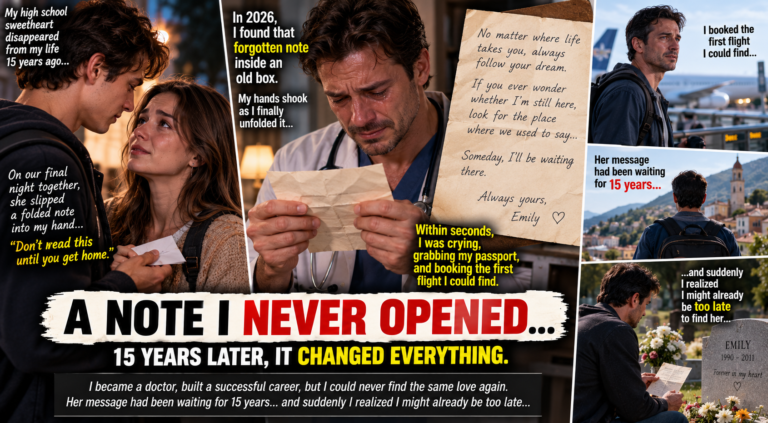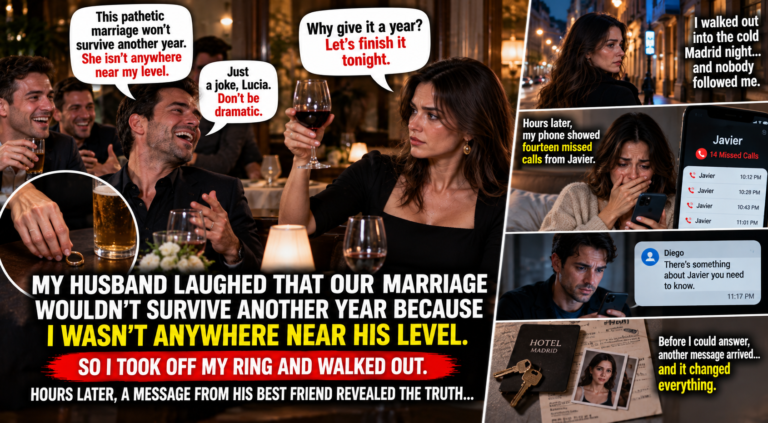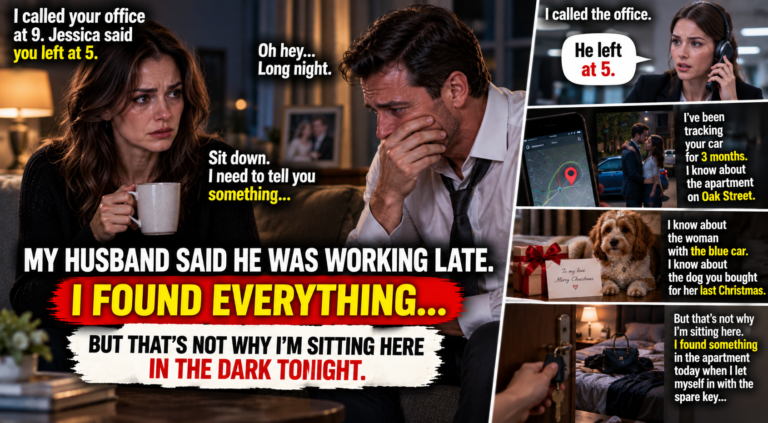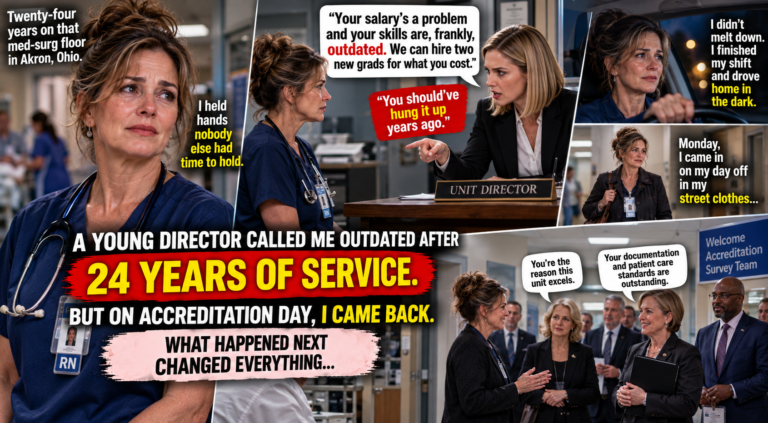


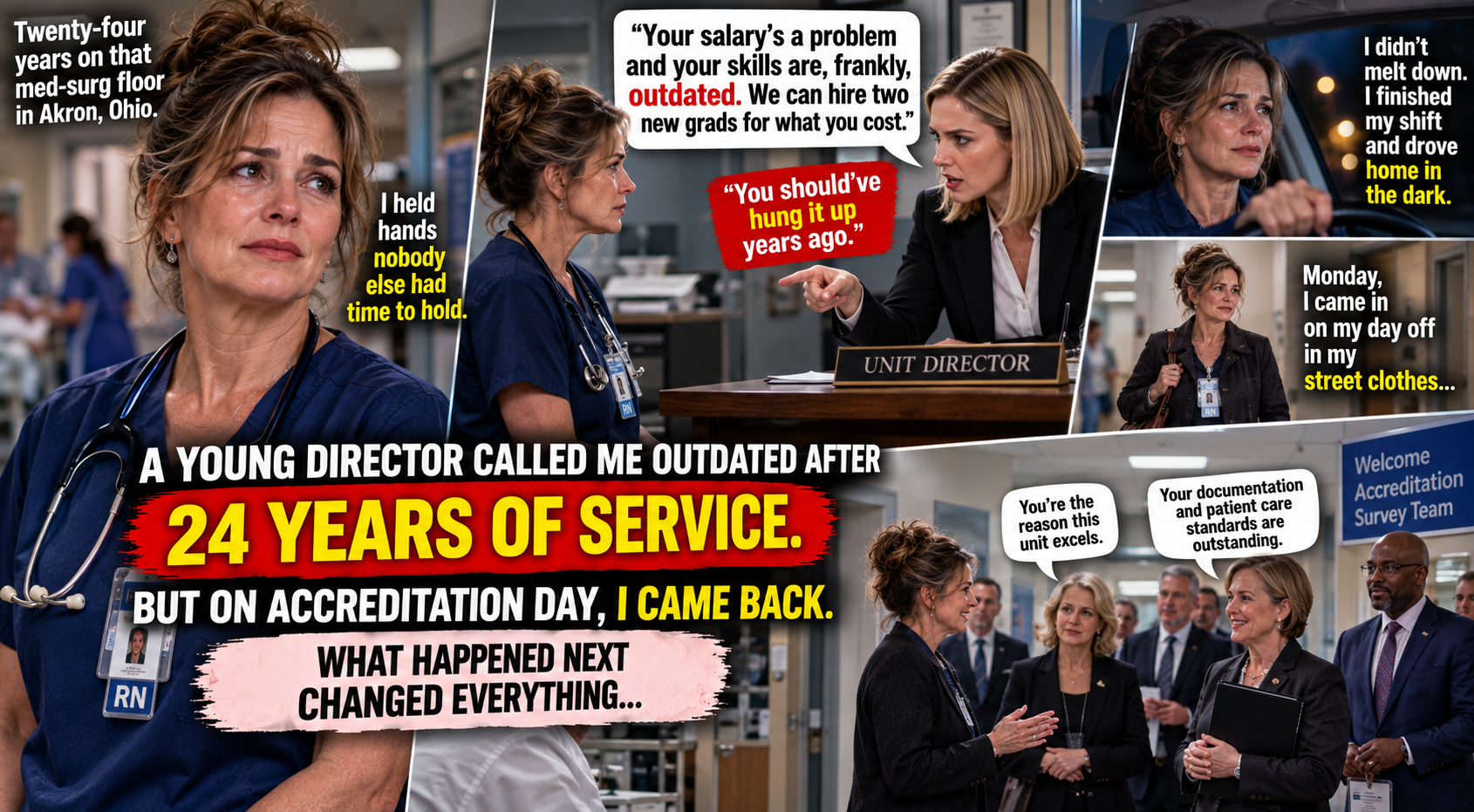
Twenty-four years on that med-surg floor in Akron, Ohio.
I precepted a whole generation of nurses.
I caught mistakes that could have made the papers.
I held hands nobody else had time to hold.
I had worked through night shifts, holidays, short staffing, power outages, flu seasons, and more code blues than I could count.
I knew that floor better than anyone.
Then a young unit director with an MBA decided seniority was a line item.
She didn’t even look up from her monitor.
“Your salary’s a problem and your skills are, frankly, outdated.”
I stood quietly in front of her desk.
She continued typing.
“We can hire two new grads for what you cost.”
Then she finally looked at me.
“I’d start job hunting quietly if I were you. Nobody’s fighting to keep a nurse who should’ve hung it up years ago.”
Outdated.
The word stayed with me.
Twenty-four years of code blues, and apparently I should’ve hung it up.
I didn’t melt down at the station.
I didn’t argue.
I simply said:
“Thank you for being direct.”
Then I finished my shift.
I charted every last note.
I checked every medication.
I made sure the night nurse knew exactly what each patient needed.
And then I drove home in the dark.
I cried only after I got inside my house.
Not because I believed her.
Because I couldn’t believe that twenty-four years could be dismissed in less than five minutes.
The next morning, I woke up angry.
But by breakfast, the anger had turned into something else.
Resolve.
I didn’t update my résumé.
Not yet.
Instead, I opened a folder I’d been keeping for years.
It contained copies of everything I had ever documented about that unit.
Patient-safety reports.
Staffing concerns.
Medication near-misses.
Incident reports.
Training records.
Competency checklists.
Emails I’d sent to management warning them about problems.
I had never kept those records because I planned to use them against anyone.
I kept them because patients deserved continuity.
But now I realized something.
My twenty-four years weren’t just memories.
They were documented.
Every near miss.
Every correction.
Every training session.
Every time I’d spoken up when something wasn’t safe.
And Monday was coming.
Monday was the hospital’s annual accreditation survey.
The board would be there.
Senior administrators would be there.
External surveyors would walk through the unit.
They would review documentation.
They would interview staff.
They would observe patient care.
And that visit could make or break a director’s career.
The young director knew it.
Everyone knew it.
On Sunday night, I received a text from one of my former preceptees.
“Are you really not working Monday?”
I replied:
“No. I’m off.”
She sent another message.
“Please come.”
I frowned.
“Why?”
“Because something isn’t right.”
I didn’t ask for details.
I simply decided to go.
Monday morning, I came to the hospital in street clothes.
No scrubs.
No badge around my neck.
No clipboard.
I wasn’t scheduled to work.
I was there as a visitor.
The accreditation surveyors were already on the floor.
The unit director, Amanda, was walking beside them.
She looked nervous.
I stood near the nurses’ station.
She saw me.
Her expression immediately changed.
“What are you doing here?”
“I’m off today.”
“I know.”
She looked uncomfortable.
“You shouldn’t be interfering with the survey.”
“I’m not.”
One of the surveyors approached us.
She was an older woman with a calm expression.
“Are you a nurse here?”
I nodded.
“I was.”
Amanda quickly interrupted.
“She is currently not scheduled.”
The surveyor looked at me.
“How long have you worked here?”
“Twenty-four years.”
The surveyor’s eyebrows rose.
“Twenty-four?”
“Yes.”
She smiled.
“Then you probably know this unit very well.”
I said nothing.
Amanda looked irritated.
The surveyor turned back to her.
“Could we speak with her privately?”
Amanda’s face went pale.
“Of course.”
I followed the surveyor into a small conference room.
She closed the door.
Then she asked:
“Tell me what you know about this unit.”
I took a breath.
“I know what works.”
“And what doesn’t?”
I looked at her.
“That depends on whether you want the polite answer or the honest one.”
She smiled.
“The honest one.”
So I gave it.
I didn’t exaggerate.
I didn’t attack Amanda.
I didn’t mention what she had said to me.
I simply described what I had observed.
Staffing gaps.
Medication scanning problems.
New nurses being assigned patients without adequate orientation.
Incomplete handoff procedures.
Equipment checks that were sometimes signed without actually being completed.
And one particularly dangerous problem.
A medication storage issue that I had reported months earlier.
The surveyor wrote everything down.
Then she asked:
“Do you have documentation?”
“Yes.”
I had brought copies.
Not because I expected this conversation.
Because I had always kept records.
The surveyor studied them.
Her expression became serious.
“Why wasn’t this corrected?”
“I don’t know.”
“Who did you report it to?”
I gave her the names and dates.
She looked at me.
“Did management respond?”
“Sometimes.”
“And the problem remained?”
“Yes.”
She closed the folder.
“Thank you.”
I returned to the nurses’ station.
Amanda was waiting.
“What did you tell them?”
“The truth.”
She stepped closer.
“You have no right to sabotage this hospital.”
I looked at her.
“I didn’t sabotage anything.”
“You know what this survey means.”
“Yes.”
“You could cost people their jobs.”
I answered quietly:
“I could also help prevent someone from losing their life.”
She went silent.
The survey continued.
For several hours, the external team reviewed charts and procedures.
Then they began interviewing nurses.
One of them asked a young nurse:
“Do you feel comfortable reporting a safety concern?”
The nurse hesitated.
Then looked toward Amanda.
That hesitation said more than words could.
The surveyor noticed.
Later, they asked another nurse the same question.
This time, the nurse said:
“Honestly? Sometimes we’re afraid we’ll be labeled difficult.”
I looked down.
I knew exactly what she meant.
Then the surveyors discovered something else.
Several corrective-action forms had been marked as completed.
But the underlying problems were still there.
Amanda tried to explain.
“We’ve been working through a transition.”
One surveyor asked:
“When was this issue resolved?”
Amanda gave a date.
The surveyor opened a report.
“This incident occurred after that date.”
Amanda froze.
I didn’t say anything.
I didn’t need to.
The documents spoke for themselves.
By the afternoon, the board members had arrived.
The hospital CEO joined the meeting.
Amanda looked increasingly nervous.
Then one of the surveyors asked to speak with the CEO privately.
I waited outside.
Twenty minutes later, the CEO walked out.
He looked at me.
“You’ve been here twenty-four years?”
“Yes.”
He shook his head.
“Why didn’t I know how much you were doing?”
I smiled sadly.
“Because nurses usually don’t make the news when we prevent something from going wrong.”
He looked down.
Then he asked:
“Who told you your skills were outdated?”
I didn’t answer immediately.
Finally, I said:
“My unit director.”
He sighed.
“I see.”
That evening, the board held an emergency meeting.
I wasn’t invited.
I didn’t expect to be.
I went home.
I thought the whole thing was over.
At 9:17 p.m., my phone rang.
It was the hospital CEO.
“Can we meet tomorrow morning?”
I hesitated.
“Why?”
“I think you deserve to hear what happened today.”
The next morning, I returned to the hospital.
This time, I wore my scrubs.
Not because I had to.
Because I wanted to.
The CEO was waiting in a conference room.
Two board members were there.
So was the chief nursing officer.
Amanda was not.
The CEO gestured toward a chair.
“Please sit.”
I did.
He looked at me.
“The accreditation team found significant concerns on the unit.”
I nodded.
“They also reviewed the documentation you provided.”
I remained silent.
“They found that several problems had been reported repeatedly.”
I nodded again.
“And they found that some corrective actions had been documented as completed when they were not.”
My heart sank.
“How serious?”
“Serious enough that the board is taking immediate action.”
He paused.
“Amanda is being removed as unit director.”
I didn’t celebrate.
I simply breathed.
The chief nursing officer leaned forward.
“We also want to offer you something.”
I looked at her.
“We want you to become our senior clinical educator for the med-surg division.”
I was stunned.
“Me?”
“Yes.”
“You said my skills were outdated.”
The room became silent.
The CEO looked at me.
“Who said that?”
I almost smiled.
“Never mind.”
He shook his head.
“No. I want to know.”
I told him.
He looked at the chief nursing officer.
She sighed.
“We have reviewed your training records.”
She slid a file across the table.
“You’ve precepted more than fifty nurses over the years.”
I looked down.
“I didn’t count.”
“You also helped develop several protocols that are still being used.”
“I didn’t know that.”
“You trained nurses who are now charge nurses, educators, nurse practitioners, and managers.”
She paused.
“And the surveyors specifically mentioned the quality of your documentation.”
I stared at the file.
For twenty-four years, I had assumed my work was simply my job.
Apparently, it had become part of the hospital’s foundation.
The CEO leaned back.
“Your salary was called a problem.”
I looked at him.
“We ran the numbers.”
He smiled.
“Replacing your experience with two new graduates wouldn’t save us what they thought it would.”
I didn’t respond.
“Because experience isn’t just a salary.”
He continued.
“It’s judgment.”
That sentence stayed with me.
Judgment.
Knowing when a patient’s breathing had changed.
Knowing when a family member wasn’t telling you everything.
Knowing when a medication order didn’t look right.
Knowing when a new nurse was overwhelmed even though she said she was fine.
You can’t put all of that into a spreadsheet.
That afternoon, I returned to the floor.
My former colleagues were waiting.
One of them hugged me.
Another cried.
One of the younger nurses said:
“I thought they were going to push you out.”
“So did I.”
She shook her head.
“We need you.”
I smiled.
“No.”
I corrected her.
“You need good systems.”
She smiled.
“And we need people who know how to build them.”
That became the beginning of a new chapter.
I accepted the clinical educator position.
But I made one condition.
I wanted nurses to be able to report safety concerns without fear of being labeled difficult.
The board agreed.
We created a new reporting process.
Anonymous reporting.
Regular safety reviews.
Mentorship for new nurses.
Protected education time.
And a rule that patient-safety concerns could not be dismissed simply because the person reporting them was junior.
The changes took time.
But they worked.
Six months later, the same unit that had been struggling received a strong accreditation result.
The CEO asked me to attend the board meeting.
He stood before everyone and said:
“This hospital almost lost one of its most valuable nurses because we confused experience with expense.”
I looked around the room.
I didn’t feel victorious.
I felt relieved.
Because the story wasn’t really about me.
It was about every nurse who had ever been told they were too old.
Too expensive.
Too slow.
Too experienced.
Too difficult.
Sometimes the person you call “outdated” is the person who remembers why the rule exists in the first place.
Sometimes the quiet employee who never asks for recognition is the one holding an entire system together.
And sometimes the most powerful response to disrespect isn’t an argument.
It’s documentation.
It’s professionalism.
It’s doing the job so well that when someone finally looks closely, they can’t deny what you’ve accomplished.
I never received an apology from Amanda.
I didn’t need one.
A few months later, I passed her in the hospital hallway.
She looked away.
I simply nodded.
There was no anger left in me.
Only gratitude.
Because if she hadn’t told me my skills were outdated, I might never have realized how much knowledge I had accumulated.
I might never have opened those old files.
I might never have spoken to the surveyors.
And I might never have discovered that my greatest value wasn’t measured by my salary.
It was measured by the people I had trained.
The patients I had protected.
The mistakes I had prevented.
And the hands I had held when nobody else had time.
Twenty-four years later, I’m still a nurse.
But now, when a new nurse walks onto that floor, I tell them something I wish someone had told me years ago:
“Don’t confuse being quiet with being invisible.”
Your work matters.
Your experience matters.
And if someone ever tells you that everything you’ve learned is outdated…
don’t waste your energy trying to convince them.
Keep showing up.
Keep learning.
Keep documenting.
Keep protecting your patients.
Because eventually, someone will look closely.
And when they do…
make sure the evidence tells your story.
About the Author